 |
|
ANNONA MURICATA L - SOURSOP.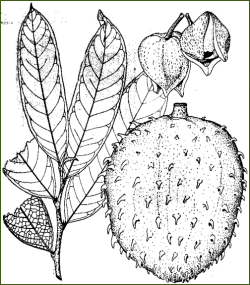 Common names
Nangka blanda, soursop, guanabana, graviola, prickly custard apple, durian benggala, zuurzak, Brazilian paw paw, sirsak, Sauersack. Family Annonaceae (Annona family). Overview Graviola (Soursop) belongs to the genus Annonaceae and comprises about 150 species. It is a small tree of tropical South America, no more than 20 feet tall; the oblong to oval leaves are leathery, very dark and shiny green. They have a pungent odor when crushed. The tree has larger individual yellow flowers on woody stalks (pedicels). Graviola fruit is prickly and oblong or somewhat curved; with a length of 13 inch and a weight of up to 8 pound. The tree may bear fruits anywhere on its trunk or branches. The fruit has 40 - to 100 black seeds. The creamy, aromatic pulp is used in ice cream and as a juice: it is rich in vitamin B and C. It has a musky, sub - to acid flavor. Pharmacology Graviola is used extensively in alternative cancer treatment and prevention; it has a high success rate. There are phytochemicals in the leaves, seeds and stem of the graviola which are cytotoxic against various types of cancer cells. There is ongoing cancer-research on this plant concerning the specific phytochemicals (Annonaceous acetogenins) that are demonstrating the strongest anticancer and antiviral properties. It seems that in contrast with chemotherapy, that indiscriminately seeks and destroys all actively reproducing cells, Graviola selectively target enemy cells. It leaves all healthy and normal cells undisturbed. Research has indicated that the Annonaceous acetogenins* kill malignant cells of 12 different types of cancer including breast, ovarian, colon, prostate, liver, lung, pancreatic and lymphoma. All parts of the tree are used in natural medicine; the bark, leaves, roots, fruit and seeds. Soursop has an important place in traditional- and alternative medicine in Central- and South America. Applications are analgesic and antispasmodic. Read more about the ongoing research on Graviola at the PUBMED website. For more information: visit the "MEDICINE FROM NATURE" page. Visit also our: APPLICATION AND DOSAGE-, CANCER -, CHOLESTEROL -, DIABETES - , HYPERTENSION - and TINCTURE pages for alternative remedies on these conditions. Suriname's traditional medicine Tea of the leaves is used against edgy nerves, hypertension with nervousness. Also used against flu and fevers. Fresh leaves are used against sleeplessness (insomnia). * annocatalin, annohexocin, annomonicin, annomontacin, annomuricatin A & B, annomuricin A thru E, annomutacin, annonacin, annonacinone, annopentocin A thru C, cis-annonacin, cis-corossolone, cohibin A thru D, corepoxylone, coronin, corossolin, corossolone, donhexocin, epomuricenin A & B, gigantetrocin, gigantetrocin A & B, gigantetrocinone, gigantetronenin, goniothalamicin, iso-annonacin, javoricin, montanacin, montecristin, muracin A thru G, muricapentocin, muricatalicin, muricatalin, muri-catenol, muricatetrocin A & B muricatin D, muricatocin A thru C muricin H, muricin I, muricoreacin, murihexocin 3, murihexocin A thru C, murihexol, murisolin, robustocin, rolliniastatin 1 & 2, saba-delin, solamin, uvariamicin I & IV, xylomaticin. Hardiness USDA zone 9B - 11. Propagation Seeds and cuttings. Due to recalcitrant nature of the seeds, they have a short viable life, can not be dried well and can not withstand low temperatures. Culture Full sun / light shade, tolerant of poor soil. Plant in frost free areas or spots. Graviola is a tropical plant so it is susceptible to cold damage; damage on the foliage appears at 38° F.; serious tree damage will occur at 25° F. for mature trees. |
|
For the right freight rate, shipping charges, conditions and delivery service, please visit our Webstore page! |